


[ad_1]

There’s this certain kind of comment you start to recognize after a while.
Not the loud one. There’s no shortage of men on the internet doing little public monologues about how nobody can say anything anymore while saying plenty. We’ve had those. Humanity has had those.
I mean the other kind of comment, the quieter one. The one that appears under a piece about marriage, or fatherhood, or sex, or work, or grief, and you suddenly realize the article was only the front door. The real thing just walked in through the comments.
It usually comes in a little sideways.
A man says, I’ve never told anyone this before.
Or, I thought I was the only one.
Or, Reading this made me realize I haven’t had a close friend in ten years.
Sometimes it’s even plainer than that: Thank you. I didn’t know where else to put this.
That gets us every time.
Not because it’s dramatic. Usually it’s not dramatic at all. Usually it’s just one guy, somewhere too late at night, typing and deleting a comment three times before finally leaving the version that sounds the least humiliating. Then checking back to see if anyone answered. Not because he wants attention. Because he wants to know if he is alone. Those are different things.
I’ve always found it a little ridiculous that we wait for a trend piece to tell us what a comment section already knew.
Long before “men’s loneliness” became a headline—something neat enough for a podcast, a panel, a magazine, or a round of hand-wringing from people who had apparently just discovered men have inner lives—men were already telling us about it here. Not in polished language. Not in “thought leadership.” In the messy, half-guarded language people use when they are trying to tell the truth without sounding weak.
And for those of you who don’t know how The Good Men Project began, that matters.
We did not start because somebody saw a neat tidy market opportunity in male vulnerability. Uhm…just no. We started because there were stories about men that were either not being told, or being told so badly they barely counted. The lazy templates were everywhere back then too. Men as jokes. Men as appetites. Men as baffled husbands, overgrown boys, public threats, emotional wallpaper. Pick your stereotype.
We were interested in actual men.
Complicated men. Contradictory men. Men trying. Men getting it wrong. Men who loved their wives and children and still felt weirdly, frighteningly alone inside their own lives. Men who could talk fantasy football, mortgage rates, travel points, and whether the coach should have gone for it on fourth down—with real fluency, impressive even—and still have absolutely no idea how to answer the question, How are you, really?
That was the conversation we wanted to open. Or…more like make room for. Allow it to happen.
And almost immediately, people did what people do when they finally find even a little bit of room. They told the truth. Not always elegantly. This is still the internet, after all. But they told it in essays, in comments, in replies, in arguments, in those moments when a piece that was supposedly about one thing quietly became about another. A piece about work became a confession about isolation. A piece about sex turned, two screens down, into a conversation about tenderness. A piece about fatherhood became a man admitting he loved his kids more than anything and still sometimes felt like the least visible person in his own house.
It’s one of the things fifteen years of reader engagement will teach you: loneliness is often hiding in plain sight.
It does not always look like a man sitting alone in a dark room, nobly suffering in cinematic silence.
Sometimes it looks like a guy with a wife, two kids, a decent job, a packed calendar, a neighborhood, a group text, and absolutely no one he can call and say, without editing himself, I’m not doing great.
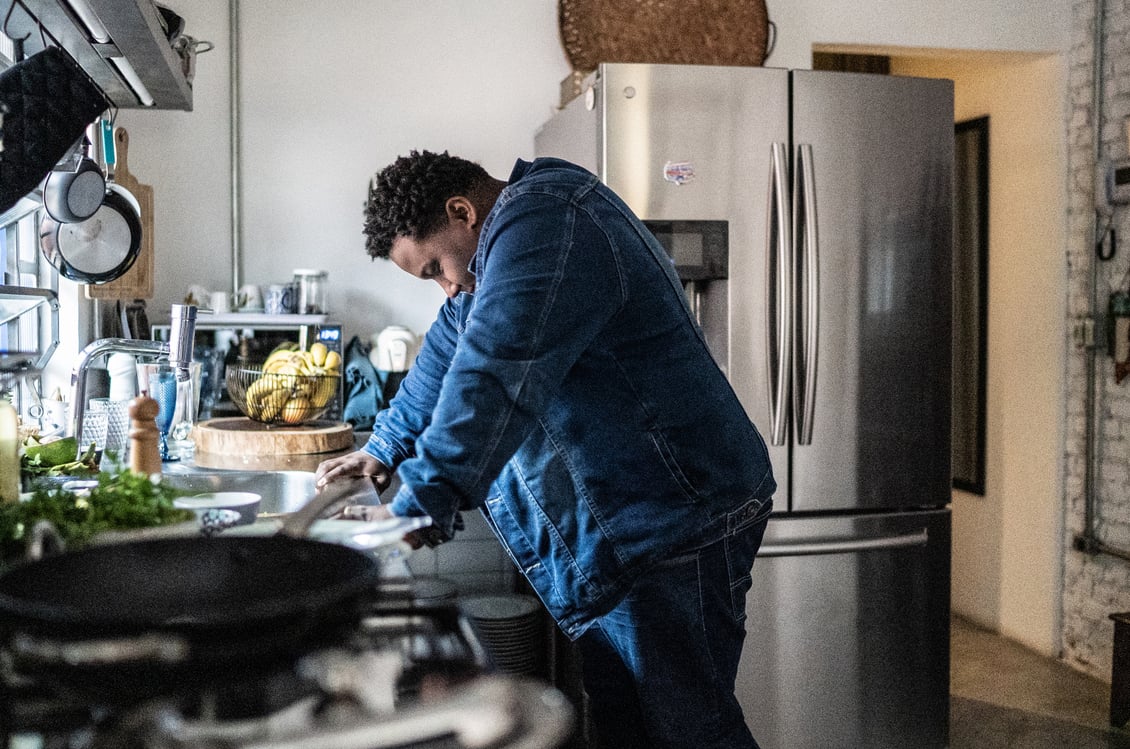
Sometimes it looks like a husband standing at the kitchen counter pretending to unload the dishwasher because he is trying not to cry and he does not want to get asked what’s wrong before he figured out how to answer.
Sometimes it looks like a father driving home after practice and taking the long way because ten extra minutes in the car feels easier than walking inside and instantly becoming the competent one again.
Sometimes it looks like a man who’s funny, generous, capable, good in a crisis—and basically unreachable in his own emotional life.
We’ve known that guy. Most people do.
A lot of lonely men don’t seem lonely at first glance. They seem busy. Or tired. Or vaguely irritable. Or hyper-competent. Or “not a big talker.” Or “just private.” Or “fine.” There are so many socially acceptable ways for male loneliness to disguise itself, it almost deserves its own publicist.
A lot of men know how to be useful. They know how to provide, solve, show up, fix, organize, absorb, endure. They know how to keep things moving. What they do not always know—because a lot of them were never taught, and many were subtly punished when they tried to learn—is how to let themselves be known before they are already in trouble.
And as they get older, things often get worse. Work gets more demanding. Marriage gets more layered. Kids arrive, or don’t. Friends drift. Parents age. Bodies change. Free time gets carved into little scraps. The structures that once made friendship easy thin out, and the deeper skills required for intimacy do not automatically appear just because a man now owns better luggage and can talk about his lower back.
This is where the public conversation can get stupid fast.
On one side, men’s loneliness gets treated like a shocking new discovery, as though men just woke up one day and said, wow, this hollowed-out feeling seems suboptimal. On the other side, people say—often with plenty of reason— yes, but women have been dealing with the emotional fallout of men’s disconnection for generations, so are we really centering men right now?
The answer, annoyingly, is that both things contain truth.
Men’s loneliness is real. So is the labor it has often cost women.
Men are often under-connected. Women are often overburdened by being asked to do the emotional translation work in heterosexual life.
Many men are starving for intimacy. Many women are exhausted from being drafted to create it.
We not especially interested in choosing one of those truths and ignore the other.
The Good Men Project, at its best, has always resisted that flattening. We have tried to let men be fully human without pretending the impact of male socialization lands nowhere. We have tried to let women tell the truth without turning men into caricatures. We have tried—not always perfectly, but genuinely—to build a place where people could say the harder thing. Where men could be lonely and defended, loving and difficult, good-hearted and not easy to live with. Where women could be compassionate and furious in the same paragraph. Because that is often where real life lives. In the mess.
And yes, we know “the mess” is not a very satisfying framework if what you want is a clean villain and a clean hero and a clean explanation you can take to lunch. But a lot of what has gone wrong in our conversations about men is that people keep trying to flatten human complexity into a morality play and then act surprised when nobody feels seen.
Which brings us to something we heard a long time ago and never forgot: seek to connect, not to impress.
We love that as writing advice. We love it even more as life advice. And we think it is especially good advice for men.
Because one of the saddest patterns we have seen, both in life and in these pages, is how many men have been trained to think impressing people is safer than connecting with them. Competence is safer than need. Polish is safer than honesty. Being in control is safer than being known. Looking fine is safer than saying, actually, no, not really.
And maybe it is safer. For a while.
But it is terrible for intimacy.
It is terrible for friendship. For marriage. It is terrible for the private self that starts to suspect, after enough years, that nobody really knows him because he has spent the whole time sending out the polished representative instead.
That is not just a men problem, obviously. Plenty of women know that dance too. But we do think there is a particularly male version of it that has been rewarded for a very long time. The man who is steady, capable, low-maintenance, unfazed. Great. Lovely. Except “unfazed” is often just loneliness wearing decent shoes.
Or loneliness with a decent income. Or loneliness coaching Little League.
Or loneliness making everybody laugh at dinner and then standing alone in the kitchen afterward, hand on the counter, not entirely sure why he feels so far away from his own life.
Before men’s loneliness was a headline, it was that.
***
And if you run a platform like The Good Men Project for long enough, you start to see something else too: men will often tell the truth if there is enough air in the room.
Not always. Some people are deeply committed to performance. But a lot of men are more ready than they look. They do want closeness. They do want language. They just do not want to be humiliated on the way there.
That matters.
A lot of men learned, directly or indirectly, that if they are open, they will lose status. If they are vulnerable, someone will use it against them. If they are uncertain, they will look weak. Sometimes that fear is exaggerated. Sometimes it isn’t. Either way, it settles into the body.
So yes, when we talk about men’s loneliness, we should talk about friendship and work and institutions and all the rest of it. But we should also talk more plainly about shame. About how hard it is to connect when your whole identity has been built around not needing too much.
And if you are a woman reading this, you probably know this story from the other side too. You may have lived next to a man whose loneliness came out as silence, irritation, overwork, or emotional absenteeism so consistent it made you lonely too.
That is real too.
Which is why I have never believed the answer was to scold men into being better at connection. Shame can produce compliance for about eleven minutes. It is not very good at producing intimacy.
People connect when there is enough dignity in the room to risk being seen. That is true in marriages, in friendships, in parenting, in writing, and yes, even in comment sections.
A man reads a piece because the headline caught him, or because his wife sent it, or because he is avoiding something else and suddenly finds himself ten paragraphs deep into an essay about fatherhood or shame or why he has no close friends, and his chest does that tight, annoying thing that means something is landing. Then, if the space feels human enough, he writes a line he would probably never say out loud.
Maybe someone answers. Maybe another man says, “I thought this was just me.” Maybe a woman says, “I wish my husband could say this.”
That is not the whole cure for loneliness. Obviously. But it is not nothing.
It is connection. Not polished. Not impressive. Real.
And that has always been one of the quiet strengths of The Good Men Project. Over fifteen years, it adds up to something I trust more than a sudden wave of public concern: lived evidence.
So yes, men’s loneliness is now a headline. Fine. But I would be careful about acting as though the headline is the discovery.
The discovery was always there: in marriages, in long silences between fathers and sons, in men who could fix anything in the house except the distance in their own lives, and in the comments under essays that were supposedly about something else.
Only connect.
That is still the work.
***
If this is the kind of conversation you want more of, join us. Sign up for our email list and stay connected to the work as it unfolds across The Good Men Project. Read us on the main site, on our main Substack, on our Dating & Relationships Substack, and across our Medium publications. If you have a story of your own, you can submit it for free through Submittable. If you want to support this work more directly, Premium Membership helps sustain the kind of independent, human conversation that made spaces like this matter in the first place.
You can also find The Good Men Project: Real Stories from the Front Lines of Modern Manhood on Amazon, which still feels like a pretty accurate description of the project.
For authors, experts, and organizations that want to contribute to these conversations in a larger way, our Author Amplification Program offers additional distribution and ecosystem support. We also offer paid guest posts, sponsored articles, and bulk guest post packages. Please email info@goodmenproject.com for more information.
***
But lightly, and last. The bigger point is the one it has always been: before the culture had a headline, people were already trying to tell us the truth.
And if you’ve been here for a while, you know that is what we’ve been listening for all along.
—
Photo: iStock
The post Before “Men’s Loneliness” Was a Headline, It Was a Comment Section appeared first on The Good Men Project.
[ad_2]
Source link
