


Ever wonder how your personality affects the way you work and communicate with others? The DISC assessment, one of the world’s most widely used personality tests, offers helpful insights. DISC is an acronym for the four traits measured in the assessment—Dominance, Influence, Steadiness and Conscientiousness—which can influence behavior, communication style and work preferences.
Understanding each trait is essential to benefit from DISC test results. This is sometimes challenging as they can be difficult to read. However, knowledge gained from DISC assessments can make you more effective at work and highlight opportunities for personal and professional growth. In this guide, you’ll learn how to read and decipher your results, break down each of the test’s four main traits and understand what different scores reveal about your personality and behavior.
DISC Assessment Explained
The DISC assessment is an online test consisting of 20 to 75 statements. One example might be, “I like to be involved in group projects.” The goal is to reflect on each statement and rate it on a scale of how strongly you agree or disagree or how well it describes you. The test usually takes 10 to 15 minutes to complete. While there’s no optimal result, understanding the personality traits we favor can reveal our strengths, weaknesses, preferences and motivations. It can also help us connect with different personality types and handle difficult situations more effectively.
The 4 DISC Assessment Categories
Here’s a rundown of the four DISC assessment categories:
- Dominance: “D” styles are assertive, confident and goal-driven. They’re quick decision-makers and leaders who work well under pressure.
- Influence: “I” styles are known to influence and persuade others. They’re enthusiastic, optimistic and encouraging leaders.
- Steadiness: “S” styles are patient, empathetic team players. They’re sincere, dependable and cooperative.
- Conscientious: “C” styles are analytical, detail-oriented and objective. They’re likely to see things others might miss.
How To Read And Interpret DISC Personality Test Results
DISC test results are generally delivered as a series of DISC assessment charts. While these might seem complicated at first glance, they don’t have to be. In the following sections, we’ll break down the key components of each and explain how to interpret them.
Understanding DISC Assessment Charts
DISC results come in two formats: circle charts and profile graphs.
DISC Circle Charts
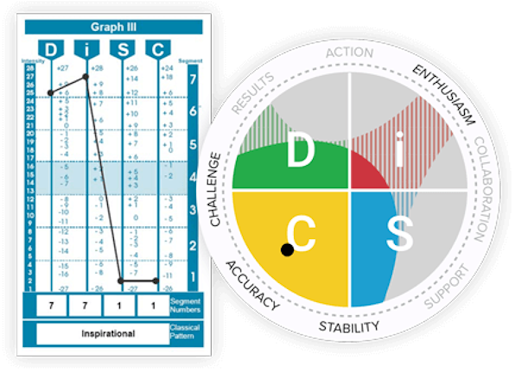
The DISC assessment circle chart is divided into four sections, each representing one of the four DISC personality traits: Dominance, Influence, Steadiness and Conscientiousness. The shaded section indicates your primary DISC trait. In some cases, the chart may also display sub-traits within the main traits, such as empathy within the Influence section. This provides a more detailed understanding of your DISC test results.
A dot on the circle shows your dominant trait and average score. For example, in the illustration above, the dot reveals Dominance as the primary trait. However, the dot’s proximity to the “C” also indicates some characteristics of Conscientiousness. If the dot appears on the line between Dominance and Conscientiousness, you align with both traits equally.
DISC Profile Graphs
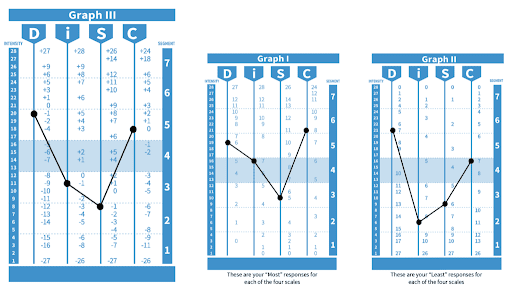
In addition to the circle chart detailed above, your DISC assessment might include a series of three DISC profile graphs: your adapting profile, your natural profile and a summary of the first two.
- Adapting profile: Reveals how you act in public
- Natural profile: Represents your private or core personality profile
- Summary: Combines results from your adapting profile and natural profile for a holistic view
Each of the three DISC profile graphs has four columns representing the four DISC personality traits. The results on these three charts range from 0 to 100, with 0 at the bottom and 100 at the top. Scores are indicated by dots in each column and are connected by a solid line. Scores above 50 (the energy line) are high, the highest of which is your dominant trait, while those below 50 are considered low.
Score Ranges And Their Significance
DISC test results indicate primary personality traits as well as areas where you scored lower. Below, you’ll learn what high and low scores mean for each DISC trait.
- High “D” scores indicate a take-charge attitude focused on success. This person is unafraid of conflict, performs well under pressure and thrives in intense environments.
- Low “D” scores reflect someone who would rather win as a team than as an individual. They tend to be more thoughtful, calm, deliberate and supportive.
- High “I” scores indicate a social individual who enjoys working with others. They’re often friendly, talkative, enthusiastic, expressive and optimistic.
- Low “I” scores mean someone who prefers to work independently. They’re likely to be reflective, good listeners, introspective and deliberate in how they process situations.
- High “S” scores are people who like well-defined routines. They’re organized, resistant to change and often need time to adapt to new situations. They tend to be patient and supportive and prefer clear expectations.
- Low “S” scores reflect individuals who are spontaneous, flexible, adaptable and like variety.
- High “C” scores align with people who prioritize accuracy, competency and consistency. They solve issues with well-thought-out solutions, are detail-oriented and thrive with rules and procedures.
- Low “C” scores are individuals who tend to think of rules as suggestions. They prefer less structure and details. They’re typically risk-takers and tend to be carefree and visionary.
Identifying Your Dominant And Overlapping Traits
On Your Circle Chart
The shaded area on a circle chart reveals your dominant trait. A dot will appear in the shaded area, but pay particular attention to exactly where it is. The closer the dot is to the outer circle, the stronger that dominant trait. Additionally, when the dot falls near a neighboring trait, you might also have characteristics similar to that personality type.
On Your Profile Graphs
The highest dot on a profile graph indicates the behavioral trait you exhibit most prominently. The next highest dot is your second strongest trait.
Recognizing Your DISC Patterns
While it’s helpful to pinpoint your dominant trait, combinations of scores across different DISC assessment categories can significantly influence overall behavior. “DISC traits do not work in isolation—they interact to create a fuller picture of your personality,” says clinical psychologist Carolina Estevez, Psy.D. “The beauty of the DISC assessment is that it highlights how these traits blend to make you unique. Knowing your combination helps you understand why you might thrive in certain situations and struggle in others.”
The 15 Classic DISC Patterns
The 15 classic patterns represent combinations of the four common DISC traits. Each combination has a different name. Understanding these patterns offers a more detailed picture of how your traits interact. Here is a list of all 15 classic DISC patterns.
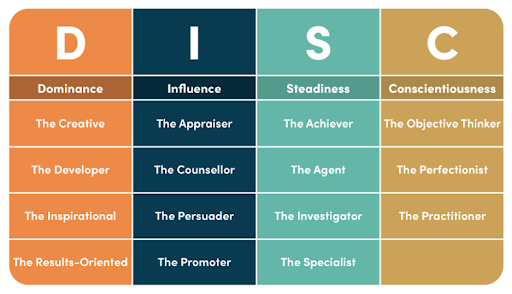
To find your pattern, look at your DISC test results and focus on your primary and secondary traits. For example, the following test results indicate the “Promoter” personality type.
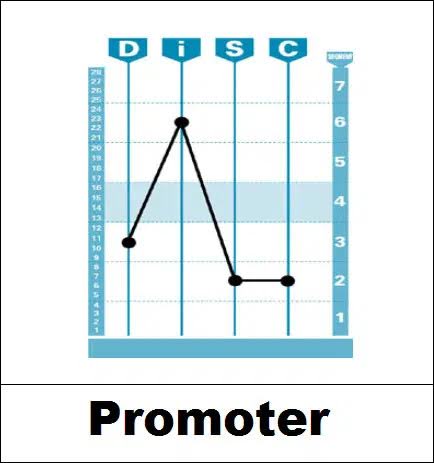
In the profile graph above, the “I” is the only trait above the energy line, which means it’s the only dominant trait. The “I” is not affected by other personality style influences. More examples include the “Perfectionist,” which is a primary “C” and secondary “S,” and the “Persuader,” which is a primary “I” and secondary “D.”
Estevez further explains, “If you score high in both Dominance and Influence you are likely a go-getter with much energy. You are bold, action-oriented and love rallying others around your ideas. People with this combo are natural leaders who like to take charge and motivate others enthusiastically.” Alternatively, “If you have a low Dominance score but high Steadiness, you will likely be more easygoing and cooperative. You prefer collaboratively working with others rather than leading from the front. You are calm, supportive and often the peacemaker in group situations.”
How To Apply Your DISC Results
DISC test results are a valuable tool to understand yourself and others. The insight gained from your DISC score is instrumental for teamwork, conflict resolution, leadership and personal growth. Below are practical examples of how to apply DISC insights in various settings.
In Your Professional Life
When it comes to teamwork and resolving conflicts at work, communication is key. “For instance, high-D individuals appreciate direct, no-nonsense communication, while high-S individuals might prefer a more collaborative and supportive tone,” Estevez explains. “Adjusting how you interact can make teamwork smoother and more productive.”
As A Leader
DISC test results can help you motivate your team, making it a valuable tool for leaders. “High-I people love recognition and encouragement, while high-C individuals are more motivated by clear expectations and logical feedback,” says Esteves. “Understanding these preferences can inspire your team more effectively and keep everyone engaged.”
In Your Personal Life
As for personal growth, DISC test results help you play to your strengths and identify areas of growth, allowing you to focus on what you do best while embracing opportunities to become a better you. For example, if your dominant score is “D,” your strengths include taking charge of projects and making decisions. Areas of growth might be practicing empathy and listening to others. This means you’ll get results while gaining more collaborative relationships.
Takeaways
DISC test results are a powerful tool for assessing yourself and others. Learning to interpret them can catalyze opportunities for intentional growth and sustained success. By understanding what each DISC trait means and how they combine to determine unique behaviors, communication styles and work preferences, you can build stronger teams and thrive both personally and professionally.
Photo by insta_photos/Shutterstock
